
Copyright 2026 by Louis Flores. All Rights Reserved.
This is the Introduction to the serialized book, The Fight For NYCHA, by Louis Flores.
A blow-by-blow account of one fight to save public housing in New York City from privatization and demolition.
On the day of our first hearing before the judge in our case, there was a line of people waiting to get in. A line. There had never been a line to get into any event that our group, Fight For NYCHA, had ever held. Don’t get me wrong. We’d had successful events, including a very pivotal town hall meeting and an effective protest outside of City Hall. But this was different. Everything was at-stake. And complete strangers had shown up. Hundreds of them.
I didn’t know exactly what Fight For NYCHA was going to be when I co-founded the group with Michael Belcher. Later, we were joined by Minista Jones, Robert Thibault, and Marni Halasa. But I wanted to pressure the political system to stop the privatization of public housing. Public housing was all that stood in the way of the powerful Real Estate Board of New York and the Partnership for New York City, two big business lobbying groups, from displacing the residents of our metropolitan Bedford Falls for Pottersville.
The then-president, Barack Obama, had passed a mechanism to let public housing pass into the management of the private sector through a scheme named Rental Assistance Demonstration, or RAD. Soon after its implementation, RAD began to develop a poor reputation for the bad deal it represented to public housing tenants. Tenants faced the possibilities of being rescreened, which was a euphemism for rejection by the private sector Landlord, or being evicted over violations of new, restrictive house rules that could become events of lease termination. We collected a hit list and published a Web site to educate the public. To try to avoid the bad press, the then-mayor, Bill de Blasio, implemented RAD under a different name, Permanent Affordability Commitment Together, or PACT. These were Orwellian names to make upward transfers of strategic, public assets to the private sector palatable to liberal moderates. And it was largely working. Which is why I knew we had to do something to stop the spread in New York.
This was our third Court case since 2019. Our first case, in Federal Court, sought to present the financial problems that the New York City Housing Authority, or NYCHA, was left to deal with in the wake of a settlement with the Federal Government over its failure to maintain physical condition standards required by law. NYCHA is the Nation’s largest public housing authority, and its problems were emblematic of the Nation’s public housing stock as a whole : Public housing wasn’t being adequately maintained. One focus to our case was on the lack of money for heating repairs in the winter of 2019-2020. But our lawsuit was immediately thrown out by the chief judge, who was apparently not interested in relitigating the abject conditions at NYCHA, even if it meant that public housing tenants faced a brutal winter.
After we regrouped, we filed a second case in State Court in 2021. That action, an Article 78 Petition, was largely based on a legal action brought in 2019 by then Borough President Gale Brewer (D-Manhattan). At that time then, the de Blasio administration proposed a plan to let a private real estate developer build a market rate building in open spaces on the campus of the Holmes-Isaacs public housing development in the Upper East Side. That kind of approach to building was called infill. But that plan was withdrawn once Brewer presented her case, namely, that the mayor was subverting the public review process that determines changes to land use. The legal framework for that pubic review process is known as the Uniform Land Use Review Procedure, sometimes referred to as the ULURP Process or just simply ULURP. We were expecting a similar result. However, the judge in our second case ultimately ruled, in summary, that we had filed too early.
For our third case, I made sure that we filed on-time, and we did. Now, we waited for the judge to take his seat in a very large Courtroom at 60 Centre Street, and the benches were packed with people.
Months before our hearing, we’d had a protest outside a chopped-up Gilded Age mansion on the Upper East Side, where NYCHA’s chairman, Jamie Rubin, and others called home. Only four people came to that protest. Sometimes, four of us was a lot. A few years back, I was the only one to sleep out in front of the Federal Courthouse to protest the then-do-nothing U.S. Attorney, Audrey Strauss. As I waited for the judge to make his entrance into the Courtroom for a hearing in our third lawsuit, it was overwhelming.
Rather than stay calm, my mind was zooming through how we got to this point. It wasn’t a stereotypical, “My life flashed before my eyes,” more like a trauma response, like, the last time I felt this anxiety was when . . . . I live with irritable bowel syndrome, so when I feel anxiety, my nervousness builds upon itself until I have to go to the bathroom or else lay down and rest, if possible. After I went through security but before I waited in line to get into the Courtroom that day, I first went to the men’s room on the second floor of the Courthouse, and that helped to calm the tension in my abdomen.
In Sept. 2019, we had had a successful town hall at P.S. 33 in Chelsea. Our plan was to employ direct action and to resort to litigation as a last resort. On the eve of that town hall meeting, I received a phone call from civil rights lawyer Norman Siegel, saying he was resigning as our attorney. He used an excuse for parting ways over the fact that we were trying to raise money on Go Fund Me for our expenses. After our call, I wrote him an e-mail, saying that, since he could no longer represent us, then he would not be called on to speak at our town hall meeting. He had had a meeting with U.S. Rep. Jerry Nadler (D-N.Y. 10) that summer with some NYCHA residents, but he had selected who could attend, which was controlling and divisive. On the evening of that town hall meeting, outside of P.S. 33, several reporters were setting up their gear to interview attendees. One of the reporters asked me about Norman’s absence. “What happened to Norman Siegel ?” the reporter asked, adding, “Did you get too radical for him ?” And I answered in the affirmative. Not only was it a revelation about how hard it would be to wage a social movement within the political system, but also about through the legal system. It was a moment of clarity.
The approach that Fight For NYCHA took was the direct opposite of the professional, political party-based, politician-dependent nonprofit groups in New York. We didn’t do business as usual. Instead, Fight For NYCHA was informed by my training by direct action activists in the marriage equality movement. I had first met Alan and Iana when the residents of Chelsea and other neighborhoods were trying to save St. Vincent’s Hospital. We were up against the same White privilege ; the powerful real estate development industry ; and a long line of irresponsible politicians and political interests, including those, who held and passed down the designated White LGBTQIA seat in the City Council to each other and who were willing to sell-out the community, especially minorities, in exchange for money and power.
As Fight For NYCHA, we held political education seminars. We held meetings that workshopped direct action proposals. We were trying to mobilize NYCHA residents to fight, not only for their own survival, but for the New Deal promise of public housing, as well as for the social compact that we enter into as a functioning society subject to a Government in which the wealthy paid their fair share. It was a tall order, maybe too tall.
Three months after our first, Fight For NYCHA town hall meeting, we crashed a town hall meeting being held by Mayor de Blasio. That town hall finally showed some NYCHA residents owning this fight. Multiple public housing residents took to the microphone and called out the mayor for selling-out public housing. During the town hall, the mayor admitted that the value of real estate in Chelsea was a primary motivator for what we would call the First Plan, which was to demolish two six-story buildings to clear land for the construction of market rate apartments which would, in part, fund at least some backlog capital repairs by NYCHA. All of Fulton Houses and Elliott-Chelsea would be privatized. I remember joining the de Blasio town hall a little bit late, possibly because I came from a Community Board meeting in Spanish Harlem. At de Blasio’s town hall, George Weaver, a key Fight For NYCHA member, and I heckled the mayor from the back of a school gymnasium or cafeteria being used as a setting. George’s presence and participation were formidable and pivotal. Our heckling supported tenants, who declared that the demolition in the plan was unacceptable. A constant complaint by speakers was that public housing residents weren’t consulted on the plan before its surprise announcement.
A New York Post article about that town hall accurately reflected the tenant anger at Mayor de Blasio’s plan for demolition and privatization. Angry residents stood up to the mayor and voiced their displeasure. The photographs in that report were very dangerously compelling. Even though our first lawsuit was days away from being dismissed by the chief judge, Mayor de Blasio chose to withdraw the First Plan for Fulton Houses and Elliott-Chelsea on or around that time, based on the growing community anger to the idea of demolition and privatization. After months of protests, the political establishment couldn’t ignore the will of public housing residents. Again, like in the Brewer case, de Blasio demonstrated that whenever the community or legal resistance became too great, the premise for the need to privatize public housing real property fell apart.
Another time before that day in the Courtroom, when I carried a lot of anxiety, was the day of our protest outside City Hall to stop what politicians called the Preservation Trust. It was a public sector project finance scheme under which NYCHA’s public housing stock would be transferred to a State-run entity with certain requirements. Both the Preservation Trust and RAD/PACT sought to end Section 9 public housing, which was funded (or left unfunded) by the Government and charged residents a low, flat rent or 30 per cent. of their income as rent, and would, instead, put tenants on Section 8 vouchers, which would funnel Federal payments to the new RAD/PACT Landlords to fund the backlog of capital repairs and to return a profit for the RAD/PACT Landlords.
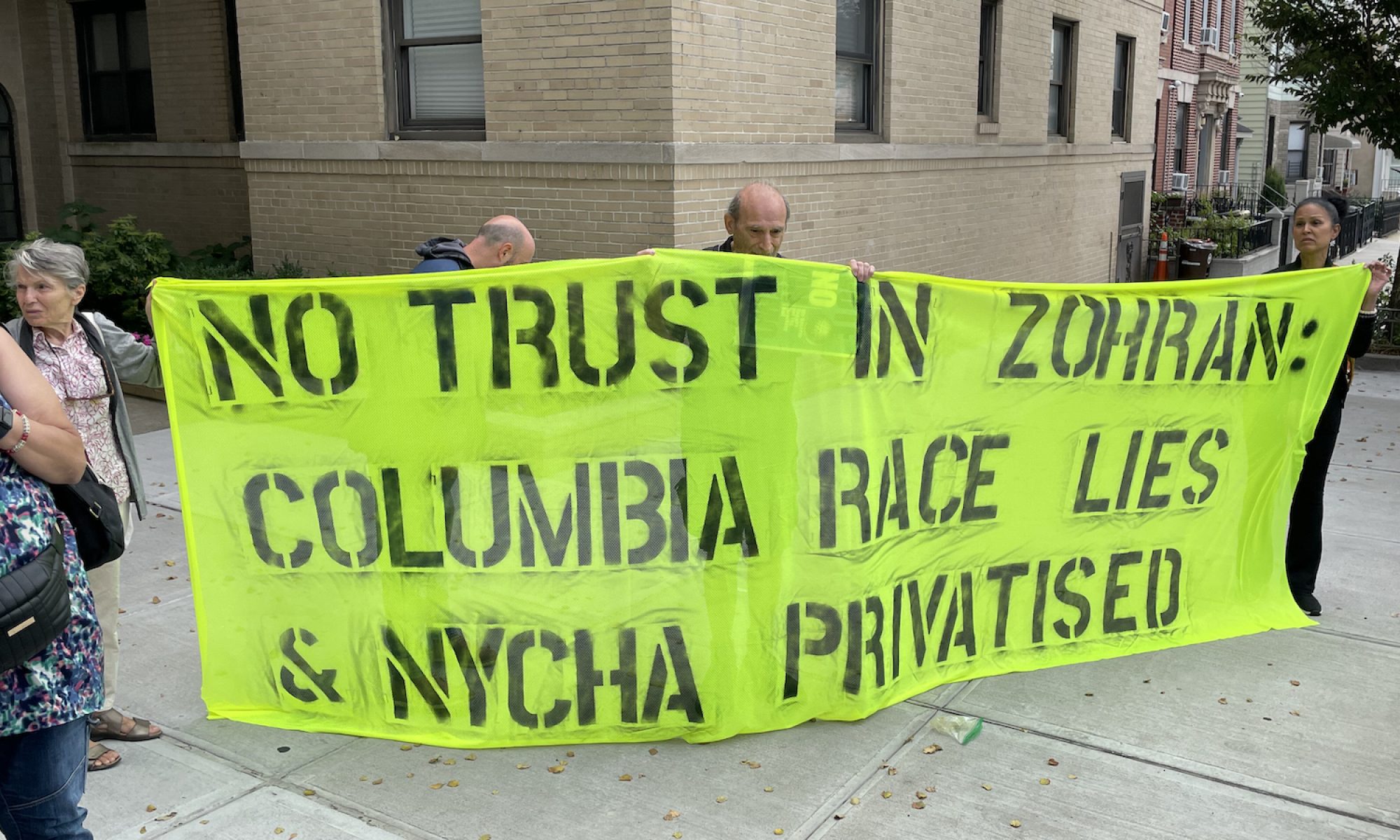
On the day of that protest outside City Hall, we had pulled together an impressive group of people. Even though our number was between 15 and 30, we were effective. Our protest was timed to coïncide with an unrelated protest by members of Democratic Socialists of America. The D.S.A., for short, were holding a protest on Broadway to call for public control over electric utilities. One of our protesters, from the Green Party, chanted at Zohran K. Mamdani, who, at that time, was increasing his profile as he set out to campaign for a seat in the New York State Assembly. Even though the D.S.A. were demanding that electric utilities be controlled by the public sector, they were, even at that time then, willing to abandon public housing to the private sector through project finance schemes, such as RAD/PACT and the Preservation Trust. It was hypocritical.
When I saw the D.S.A. protest approach ours, I signaled to our camp to step off the sidewalk and to take to Broadway. We temporarily blocked the D.S.A. protesters by taking up space on Broadway until we were cleared by the police. Doing direct action is a confrontational form of activism that can involve civil disobedience. It’s very effective. On that day on Broadway, we confronted some of those with their hands on the lever of power. But what we did, worked, because, by the next day, the State Legislator, who was a sponsor of the Preservation Trust, had pulled the bill. It would prove to be a short-term win.
In the days leading up to our first Court hearing in our third case, we were desperate to find legal help. Before we filed our third case, we took a vote at a Fight For NYCHA meeting that we would follow the same pattern as the second case, namely, that I would draft the papers (based on our last Court case) and that we would look for a lawyer to handle the motion practice. That was the only way we could move forward and still file on time. By the time we were denied a temporary restraining order to stop the demolition, we’d been turned down by so many attorneys. As a result, we approached again the same group from last winter. We thought we had finally found help. Or so we thought.
We’d had at least some legal help before. Norman’s brief representation doesn’t count. For our second case, a noted civil rights attorney looked over a draft of our Petition, and the idea of a Go Fund Me to help us pay for our expenses, which Norman had objected to, actually helped us raise money to afford legal representation during motion practice in our second case. Even though the judge in our second case had dismissed our Article 78 Petition for having been filed too early, she did rule that at least one Petitioner had legal standing to sue. That gave us a definite roadmap to follow.
Representing us on this day, before Judge James d’Auguste in our third case, were Thomas Hillgardner and John Low-Beer. Tom was an attorney, who had represented me when I was evicted from my apartment in Queens, and John Low-Beer came with the group that had promised to pay for our legal expenses. We had gone to this group before for help, in the winter before our hearing. We had attended a Zoom meeting from Marni Halasa’s apartment near Hudson Yards. The group, represented by perhaps a dozen participants, were not hesitant, but resistant. The group said that we were going to file too early again, a supposition which I opposed, providing a reasoning in response. They also said that a lawsuit would be take up too much energy when there were many other options, in summary. I explained that the lawsuit would be narrow, because it would only focus on ULURP, and the prior ruling gave us a roadmap with which to move forward. Although the premise of our Zoom was our request for help to do our lawsuit, we were told that we had to come back to them once we had an attorney, a catch-22 that is all too common when obstacles or preconditions are set to obstruct collaboration.
In the weeks leading up to what would be a disastrous hearing before the judge, I had made use of artificial intelligence in the preparation of the reply brief in our case. The Article 78 Petition was largely based on one used by Brewer in her Article 78 Petition and with suggested edits from a civil rights attorney, who took a look at a draft Petition in our second case. I had made corrections and updates for Petitioners not deemed to have standing in the prior case. NYCHA public housing residents face de facto and de jure discrimination and segregation based on source of income and source of voucher funding, particularly by the Courts. Our Petition was updated to anticipate those challenges. We filed a brief based in large part, if not copied in entire sections, from the brief in the Brewer case. When it came to us filing our reply brief, I again turned to Brewer case. I followed those arguments, amended to our fact pattern, until I ran out of case law. At that point, I turned to artificial intelligence for legal research. I googled cases to make sure that I got the citations correctly. I looked up some cases, but they didn’t exist. I couldn’t find the text of the opinions for some cases. I did the best I could. I found one case involving Columbia University, and I cited it. But the fact that there was no precise legal precedent for our case was part of the larger problem we faced. The New York bar had totally ignored the RAD/PACT and Preservation Trust conversion of public housing in New York. NYCHA was abandoned. What the political machine at City Hall wanted, they expected.
Attorneys for NYCHA notified the Judge after we filed our reply brief that there were problems with four citations in our papers. Those four citations were the only language that ever faced objection from the Respondents. That prompted an order, in due course, from the Judge, asking for an affidavit explaining our mistakes. I brought that affidavit with me to the day of our packed hearing at 60 Centre Street.
By the time of our Court hearing, NYCHA had privatized well over 20,000 public housing apartments under RAD/PACT with tens of thousands more in the pipeline. NYCHA was also making plans to roll-out Section 8 conversions under the Preservation Trust. The Preservation Trust, which we had successfully opposed in the earlier face-off with the D.S.A., was ultimately passed by the State Legislature and signed into law by Gov. Kathy Hochul (D) in June 2022. At her signing ceremony, many Democrats were in attendance, including State Sen. Julia Salazar (D.S.A.-Brooklyn), who became the bill’s chief supporter. All of the families put through those conversions lost their rights as Section 9 tenants or as NYCHA residents. They were now tenants of the brutal private sector.
In between, nobody had challenged the privatization of public housing or the subversion of ULURP in the Courts, except for Brewer and us. We were it. Everyone else rolled over and spread their cheeks for the sell-out of NYCHA. There was no other legal fight or precedent. And despite all of the talk from Norman Siegel, he’d never filed one lawsuit to stop any RAD/PACT privatization of public housing, in Chelsea or anywhere else in New York City. Neither had the Legal Aid Society or the Community Service Society. In fact, Lucy Newman and Victor Bach, from those groups, respectively, twisted the arms of public housing residents to accept RAD/PACT as a fait accompli. Even as Fight For NYCHA led protests and organized residents, some of the top housing attorneys praised for their policy experience, were calling RAD/PACT a “done deal,” language that the real estate industry and the political establishment promoted in order to squash any opposition.
At stake was not only the fate of public housing, but also ULURP, which was a legal framework by which the public could participate in land use decisions facing their own communities. But to a political system that answered to big money donors, like those at REBNY or the Partnership for New York City, democratic participation had to be neutralized in order to advance large rezonings and radical changes in land use to accommodate the gentrification and secondary displacement that underpinned sizable and rapid real estate profits.
Our third lawsuit, before Judge d’Auguste, also included a request for a City Charter § 1109 review of the role of the politicians in permitting the developer, who stood to profit from the RAD/PACT demolition of public housing in Chelsea, to circumvent ULURP. There needed to be a public review of the political negligence. But as we sought and received help from an outside group with deep pockets and deep ties to the political establishment, we would soon learn the lessons of the control strings that were attached to promises of financial help.
From the beginning, in 2019, the developer, who stood to profit from the sell-out of NYCHA public housing in Chelsea, was MAGA billionaire Stephen Ross, the founder of The Related Companies, the developer behind the heavily taxpayer subsidized Hudson Yards project. Over the course of these years, as Democrats sought to vilify Donald Trump and his network of MAGA grassroots bigots and billionaire class enablers, the local Democrats sought to suck up to Ross. But it wasn’t just politicians. Even one of the core Fight For NYCHA activists, during this time, became a commercial tenant of The Related Companies and admitted to receiving free rent from Related. To say we had to navigate impossible conditions, even with or without mistakes in our legal papers, was an understatement.
Largely from and through my participation in the no third term protests in 2008-2009, the fight to save St. Vincent’s Hospital, the tail-end of the fight for marriage equality in New York, Occupy Wall Street, the Anybody But Quinn movement in the New York City mayoral race of 2013, and the Fire Boss Crowley campaign in 2018, I’d seen how social movements could win, get coöpted, go sideways, or fail. I’d spent a lot of time examining what happened in each, what worked, and what didn’t.
Besides direct action protests, we’d also relied on heavy use of social media.
In all that time, we had gone through several Twitter accounts, each of them suspended for rules violations. We started out with @FightForNYCHA. We operated @FullyFundNYCHA as a back-up account for controversial messages (like videos that moved Anonymous-style messages). We used @NYCHAIsNot4Sale for affinity work we did with other activists. When these accounts got banned, we used @FraudSquadWatch to draw attention to how the Squad supported the RAD/PACT sell-out of public housing. When that account was suspended for rules violations, we started @StopRADPACT. The last Twitter account we have is : @LuchaPorNYCHA. We never had more than a few hundred followers, as I seem to recall. But it was one obstacle after another to get our messages out on Twitter, especially after Elon Musk bought Twitter. It was like as if accounts that pressed the social, racial, and economic justice messages, particularly of minorities, had to be stomped out. And as small as our social media accounts tended to be, we faced the implausible accusation that we were engaged in platform manipulation. It was ludicrous. But the system resorts to gaslighting whenever needed. Prior to getting banned, we also routinely received warnings and labels, indicating that Twitter regarded social media messages that advocated saving public housing as “spam.” Whether in-person or electronically, we were being told to know our place.
As Judge d’August entered the Courtroom and took his seat, the proceedings began. Our case was the first on the docket. As my mind was racing, I was thinking about how we had improbably got here, and where we were improbably heading to, next. Since this fight was about corruption, politics, money, and real estate, what was going to come next would get ugly. But of course.